
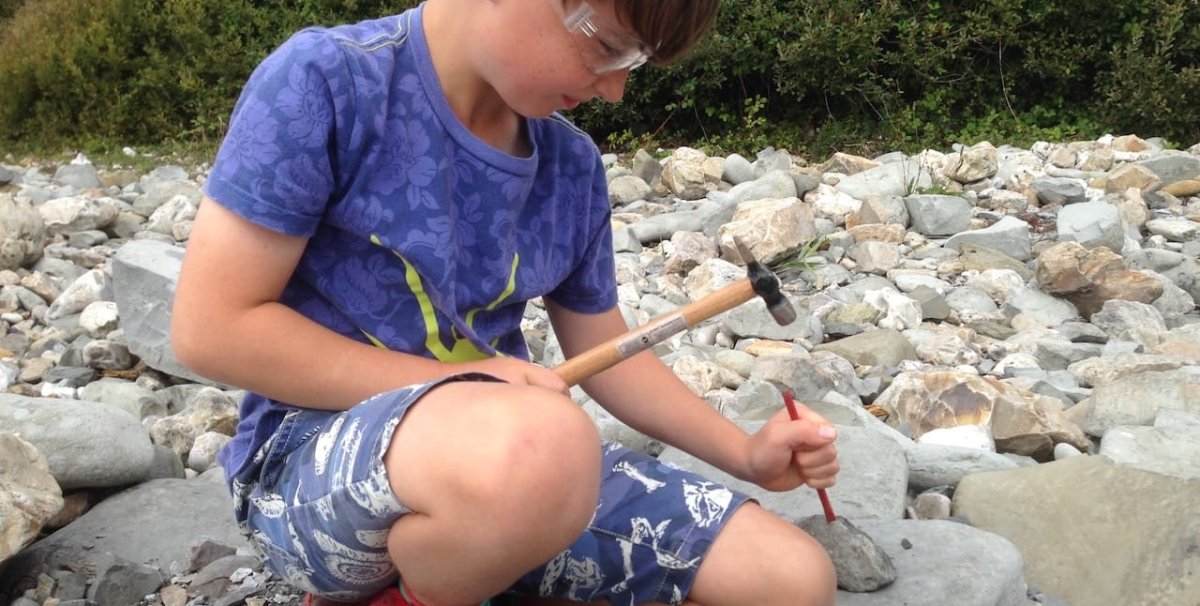
Lyme Regis is in the heart of the Jurassic Coast World Heritage Site and is considered one of the best fossil-hunting destinations in the world. You don’t need any experience or specialist equipment – just a good eye, a bit of patience, and an understanding of the tides. Here’s the Lyme Cottage guide to fossil hunting with everything you need to know before your first hunt!
Why Lyme Regis?
The cliffs around Lyme Regis are made up of Blue Lias limestone and shale (we chose this as the stone for the path at Lyme Cottage), laid down on the floor of a tropical sea between 200 and 195 million years ago during the Jurassic period. Back then, this part of Dorset was submerged beneath warm, shallow waters teeming with marine life – ammonites, belemnites, fish, and giant marine reptiles.
Over millions of years, those creatures were buried in sediment and fossilised. Today, the cliffs are constantly eroding, releasing fossils onto the beaches below. Every tide, every storm, and every winter landslip reveals new specimens. It’s a living fossil site — what you find today wasn’t on the beach last week.
This is where Mary Anning, one of the most important figures in the history of science, made discoveries that changed our understanding of the natural world. More on her story below.
What You Might Find
Ammonites – the ones everyone’s looking for!
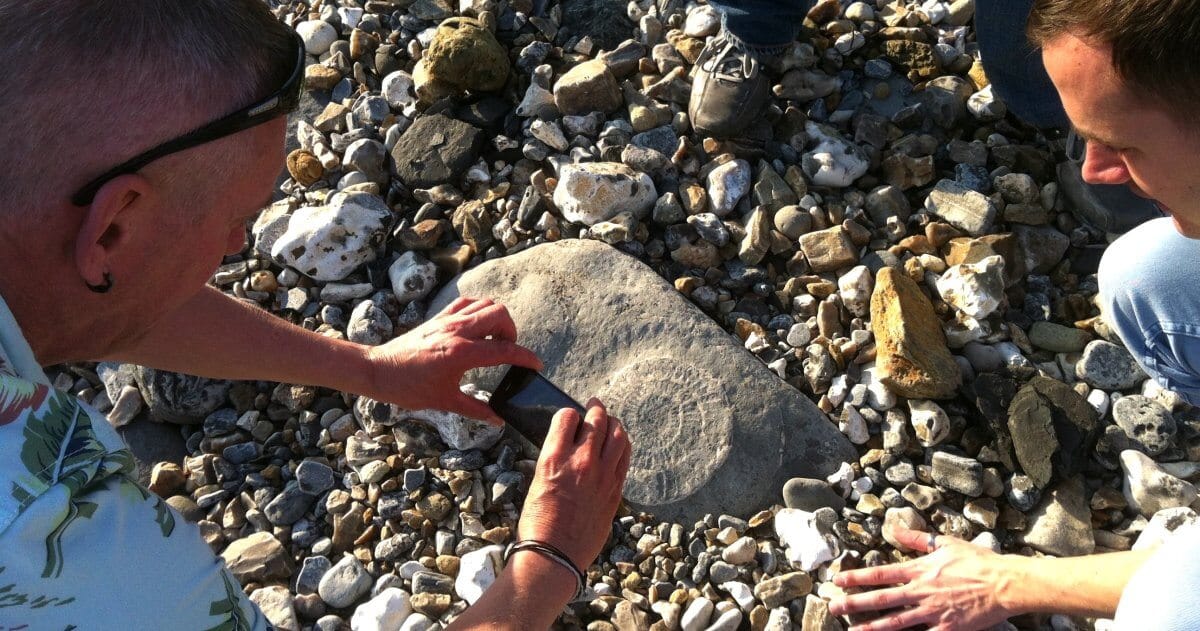
Ammonites are the iconic Lyme Regis fossil: a spiral-shaped shell, like a tightly coiled ram’s horn. They were marine animals related to modern-day nautiluses, and they lived in these waters for millions of years before going extinct alongside the dinosaurs.
On the beach, ammonites don’t always look like the polished specimens you see in museums. They’re often partial, crushed, or eroded at odd angles — you might spot just the edge of a coil poking out of a pebble, or a cross-section through the spiral. They range in size from a fingernail to more than 70cm across.
What to look for: A curved, ribbed pattern in the surface of a rock or pebble. The ribs radiate outward from a central coil. Colour varies — dark grey, brown, or sometimes a beautiful golden colour when preserved in iron pyrite (fool’s gold).
The Ammonite Pavement on Monmouth Beach is the most spectacular place to see them. It’s a natural limestone ledge covered in large ammonites, described by the Natural History Museum as the only one of its kind in the world. You can’t take these – they’re part of the rock – but they’re extraordinary to see and photograph at low tide.
Belemnites – the bullet-shaped ones!
Belemnites were squid-like creatures with a hard internal skeleton. The part you find as a fossil is the rostrum — a smooth, bullet-shaped or finger-shaped piece of calcite, typically 3-10cm long. They’re extremely common on Lyme Regis beaches and are often the first fossil a beginner finds.
What to look for: A smooth, cylindrical, pointed shape – like a stone bullet or a stubby cigar. They’re usually dark brown or grey. If you break one in half (though there’s no need to), you’ll see concentric rings like a tree trunk. Locals historically called them “devil’s fingers.”
Crinoid stems – the little discs!
Crinoids were marine animals sometimes called “sea lilies.” Their long, segmented stems broke apart after death, and the individual disc-shaped segments are common fossils. They look like small, round tokens with a hole or star-shaped pattern in the centre.
Ichthyosaur and plesiosaur bones – the rare finds
These are the ones that made Mary Anning famous. Ichthyosaurs were dolphin-shaped marine reptiles; plesiosaurs had long necks and paddle-like limbs. Complete skeletons are museum-quality finds, but loose vertebrae (sections of backbone) do turn up on the beach, particularly at the base of Black Ven.
What to look for: Ichthyosaur vertebrae are disc-shaped with a deep depression on both sides. When eroded halfway through, the cross-section looks like a bow tie. They’re not common, but they’re not impossible either — especially after storms.
Coprolites – yes, really…!
Fossilised poo from marine reptiles, sharks, and fish. Mary Anning pioneered the study of coprolites, and they’re actually quite common in the shingle. They look like dark, rounded lumps and sometimes contain tiny fish bones or scales.
Where to Hunt
East Cliff Beach & Black Ven
This is the prime fossil-hunting spot. The towering Black Ven cliffs are the largest mudslide complex in Europe and constantly deposit new material onto the beach. The Shales-with-Beef clay layers are particularly rich in ammonites and belemnites, and ichthyosaur vertebrae are found here more often than anywhere else on this stretch of coast.
Access: 114 steps down from Charmouth Road Car Park, or walk east along the beach from the town. Best at low tide — check times before you go, as it’s easy to be cut off. The museum advises going out no earlier than 2 hours before low tide and returning no later than 2 hours after.
Monmouth Beach
West of the Cobb, this pebble beach is home to the famous Ammonite Pavement – a natural limestone ledge studded with large ammonites, visible at low tide. While you can’t take fossils from the pavement itself, loose specimens in the pebbles and shingle are fair game. This is a good spot for beginners as the terrain is easier than the muddy cliffs to the east.
Access: Walk past the Cobb and continue west. Dog-friendly all year.
Church Cliff Beach
A smaller beach between Lyme and the start of the Black Ven cliffs. Good for beginners and families, with a variety of fossils in the loose material. The bronze statue of Mary Anning and her dog Tray is nearby.
Access: Walk east from the town along the seafront. Some uneven ground.
Charmouth Beach (1.5 miles east)
Many experienced collectors rate Charmouth as even better than Lyme for fossil finds. The beach is wide, the shingle is rich, and the Charmouth Heritage Coast Centre nearby offers free advice on what to look for and where. An excellent option if you want a less crowded experience.
Access: 10-minute drive or a coastal walk from Lyme. Two car parks and good facilities.
How to Hunt – Practical Tips
Timing is everything…
- Go at low tide. A falling tide is the safest and most productive time – you’re following the water out, exposing fresh beach. Check tides before every trip: The Lyme Regis tide times page gives daily predictions. As a rule, head out no more than 2 hours before low tide and start heading back no later than 2 hours after.
- Go after storms. The local motto is “the worse the weather, the better the fossil hunting.” Winter storms and heavy rain trigger cliff falls that deposit fresh material on the beach. The day after a big storm is the best time to hunt.
- Go early. Fewer people, more untouched beach. Guided walk groups tend to arrive from mid-morning.
What to bring
You don’t need specialist equipment. Serious collectors carry geological hammers and chisels, but for a first hunt, you need:
- Sturdy footwear – walking boots or wellies. The beach is uneven with loose rocks and mud. Trainers won’t cut it.
- Waterproof jacket – the weather changes fast on this coast.
- A bag or bucket – for your finds.
- Water and snacks – there are no facilities on the fossil beaches.
- A phone – for checking tide times and photographing finds before you try to move them.
Optional but useful: a small screwdriver or butter knife for picking fossils out of soft clay, and a magnifying glass for examining smaller specimens.
Where to look
- In the loose shingle and pebbles on the beach, not in the cliffs. Most fossils are found in material that’s already fallen.
- In rock pools at low tide – ammonites and belemnites are sometimes visible in the exposed rock.
- On the surface of fallen boulders – look for spiral patterns, straight lines (belemnites), or unusual textures.
- In freshly exposed mud and clay at the base of recent landslips – but never directly under the cliff face.
What to look for
Fossils in the wild don’t look like museum pieces. Look for:
- Unusual shapes – spirals, curves, straight cylinders, discs with patterns
- Unusual textures – ribbed surfaces, smooth patches in rough rock, shiny areas
- A golden glint – pyritised fossils (preserved in fool’s gold) catch the light
- Dark, blackish shapes in pale rock, or vice versa
What to do with your finds
- Small ammonites, belemnites, and crinoid stems: clean with warm soapy water and a soft brush (toothbrush works well). Don’t scrub the fossil itself — clean around it.
- Pyritised fossils: keep dry. Iron pyrite can deteriorate if left damp.
- Anything you think might be significant — vertebrae, unusual bones, large or complete specimens: take it to Lyme Regis Museum or the Charmouth Heritage Coast Centre for identification.
Seasons and fossils
- Winter (November to February): This is the prime fossil-hunting season! Storms erode the cliffs and deposit fresh material. Fewer visitors. Dress warmly!
- Spring and autumn: Good conditions, moderate crowds. Spring tides expose more beach.
- Summer: Busiest, with the most guided walks running. Fossils are very much still waiting to be found, but you’ll have plenty of company after a storm! Book guided walks well ahead.
Chat to other people on the beach. Experienced collectors are usually happy to show beginners what to look for – the fossil-hunting community here is friendly and generous with knowledge.
The Rules
Fossil hunting at Lyme Regis is legal and encouraged, but there’s a code of conduct:
- Take your litter home. Leave the beach as you found it (minus the fossils!).
- Collect from loose material on the beach only. Don’t hammer or dig into the cliffs – it’s dangerous and damages the site.
- Never stand or walk beneath the cliffs. Landslips are unpredictable and can happen without warning, even in summer.
- Check tide times before you go. People get cut off every year. Allow plenty of time to return before the tide turns.
- Report significant finds to Lyme Regis Museum or the Charmouth Heritage Coast Centre. Scientifically important fossils should be recorded, and occasionally a major find needs professional excavation.
Guided Fossil Walks
If it’s your first time, a guided walk is by far the best way to start. You’ll find more, learn faster, and stay safe. Three options run throughout the year:
Lyme Regis Museum Fossil Walks
The most popular option. Expert guides take you along East Beach and Black Ven for 2.5 to 3 hours of hunting, with background on Mary Anning, the geology of the Jurassic Coast, and tips for identifying what you find. Museum entry is included in the ticket.
- Adults: £16.75
- Children (4+): £12.75
- Students: £12.75 (NUS/ISIC card required)
- Private group (up to 8): £240
- Dogs: Welcome on the walk (not in the museum)
- Meet: Outside Lyme Regis Museum, 10 minutes before your walk time
- Book: lymeregismuseum.co.uk
Walks fill up quickly in peak season — book well in advance for summer dates.
Charmouth Heritage Coast Centre
Shorter, more affordable walks that head straight onto Charmouth Beach. The wardens send an introductory video by email before your walk, covering what to look for and how to identify common fossils.
- Adults: £14
- Children: £8 (must be accompanied by a paying adult)
- Duration: 1.5 hours
- Meet: Red lifebuoy outside the Heritage Coast Centre
- Book: charmouth.org
The Centre itself is free to enter and has excellent displays on local fossils, plus staff who can identify anything you’ve found.
Private Guided Walks
Several local experts offer private walks for small groups, ideal for families who want a more personal experience:
- Lyme Regis Fossils (Nigel Clarke and team) — private walks for up to 10 people, £100 per group, approximately 2 hours. Dogs welcome.
- Fossilwise (Chris, 45+ years of experience) — guided group walks with guaranteed fossil finds. Book at fossilwise.com.
Mary Anning – The Story Behind the Fossils
You can’t fossil hunt at Lyme Regis without knowing about Mary Anning. Born in 1799 into a poor family on the Lyme Regis seafront, she became one of the most important figures in the history of palaeontology — despite having almost no formal education and being excluded from the scientific establishment because of her gender and social class.
Her father Richard was a cabinetmaker who supplemented his income by collecting fossils from the cliffs and selling them to tourists. He taught Mary to find and clean fossils from the age of five or six. When he died of tuberculosis in 1810, the family was left in debt, and Mary — then just eleven — turned to fossil hunting to support them.
Her discoveries were extraordinary:
- 1811 (age 12): Found and excavated a five-metre-long ichthyosaur skeleton — the first to be scientifically studied. Scientists initially thought it was a crocodile.
- 1823: Discovered the first complete plesiosaur skeleton. The find was so unusual that the great French anatomist Georges Cuvier accused her of faking it, before being proven wrong.
- 1828: Uncovered the first pterosaur (a flying reptile called Dimorphodon) ever found outside Germany.
- She also pioneered the study of coprolites — fossilised droppings that revealed what these ancient creatures ate.
Male scientists bought the fossils Mary found, prepared, and identified, but rarely credited her in their published papers. The Geological Society of London refused to admit her — it didn’t accept women Fellows until 1908, more than sixty years after her death. She died of breast cancer in 1847, aged 47, still in financial difficulty.
Today, Lyme Regis celebrates her legacy everywhere. A bronze statue of Mary and her dog Tray stands near Church Cliff Beach, unveiled in 2022 after a campaign by an 11-year-old local girl called Evie Swire. The Lyme Regis Museum is built on the site of her family home and contains an extensive Mary Anning exhibition. She appears on a Royal Mail stamp and a commemorative 50p coin.
When you’re hunting for fossils on the same beaches where Mary walked, you’re following in genuinely historic footsteps.
Stay at Lyme Cottage
Lyme Cottage is a minute’s walk from the Cobb and a few minutes from the beaches where Mary Anning made her discoveries! It’s an ideal base for exploration – with two bedrooms, two bathrooms, sea views from the decking, and an open fire for warming your fingers and toes after a winter fossil hunt. Prices from £950 per week.